h-header

header
dinamic

menu-sistemi

Sprinkler fire protection systems

The development of the first true sprinkler system dates back to the middle of the last century. This technology emerged from the needs of the American textile industry, which frequently suffered devastating fires in its warehouses storing cotton, a highly flammable material.

Through the installation of a network of "dry" pipes, which could be manually pressurized with water in the event of a fire, machinery was effectively protected for the first time in the history of the industrial world.


Over the years, alongside technological progress, a wide range of sprinkler systems has been developed and successfully implemented across numerous industry sectors.
Sprinkler system types

Wet systems


In wet-pipe sprinkler systems, the entire network of piping leading to the sprinkler heads is filled with water.
Once the fire protection system activates, water flows through the piping, from the wet alarm valve to the sprinklers opened by the fire, creating a spray designed to contain the flames until the fire department arrives.

The wet alarm valve triggers a fire alarm via a motorized hydraulic bell and a pressure switch, activated by the system's operation, which can be connected to an alarm monitoring system.

Wet-pipe systems are recommended for areas not subject to freezing or to overheating (temperatures exceeding +95°C) of the water within the sprinkler distribution network.

Dry systems

In dry-pipe systems, the entire piping network, extending from the alarm valve to the sprinkler heads, is charged with compressed air.

In the event of a fire, once one or more sprinkler heads open, the air inside the piping undergoes a pressure change that causes the alarm valve's clapper to open; this allows the fire-suppression water to flow into the sprinkler network and reach the sprinkler heads.

These systems are preferred for environments where low temperatures could cause the piping to freeze.


Key areas of application

  • Paper mills
  • Chemical and pharmaceutical plants
  • Oil & Gas
  • Petroleum sector
  • Logistics centers
  • Production facilities
  • High-density warehouses
  • Underground parking garages
  • Shopping centers
  • Exhibition halls
  • Hotels
  • Hospitals and nursing homes
  • High-rise buildings
  • Offices
  • Airports and much more

High-pressure water mist fire suppression systems

Water mist systems currently represent the most advanced technology in the development of automatic fire suppression systems.

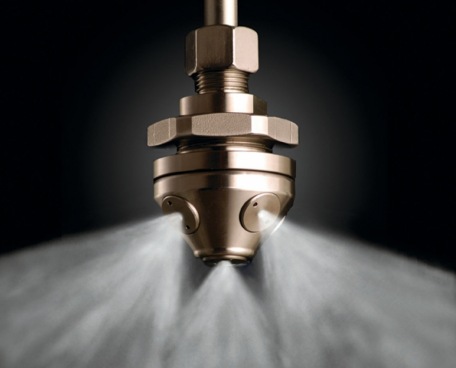
Unlike conventional sprinkler systems, water mist systems utilize the extinguishing effect of very small droplets, creating a true water mist with a droplet diameter of approximately 50 μm.

Under high-pressure conditions (> 35 bar), water is pumped through the piping and discharged via special nozzles.

The necessary pressure is generated by high-pressure pumps or, alternatively, by pressurized gas cylinders (nitrogen).

The combination of optimal droplet size and high-pressure dispersion into the environment ensures rapid, deep cooling of the combustion gases as well as at the base of the fire itself. Furthermore, the combustion gases are "cleared" from the air, allowing firefighters to access the area in question more quickly and safely.


Main areas of application

  • Luxury hotels
  • Hospitals
  • Archives
  • Warehouses
  • Painting lines
  • Gas turbines and generators in power plants
  • Engine test benches (automotive industry)
  • Wind turbines
  • Production machinery
  • Engine rooms and passenger areas on ships
  • Cable trays
  • Tunnel systems
  • Oil and gas applications
  • Automated parking systems
  • Marine and offshore systems


ESFR Fire Suppression Systems

Unlike dry or wet pipe systems, the ESFR (Early Suppression, Fast Response) sprinkler system is the only one capable of actually extinguishing a fire.

Its operation is similar to that of a wet pipe system, with pipes filled with water both upstream and downstream of the alarm valve, but thanks to larger sprinkler heads, it has the capacity to extinguish a fire, whereas other systems are designed primarily to contain and control the blaze.

Naturally, given the higher water flow rate required by the system, the piping is larger in diameter and is paired with a water supply, and a corresponding pumping station, capable of delivering higher flow rates.

settori

h-footer